06 December 2011

Earmuff season is here

I bet whoever the person is who invented earmuffs never even considered for a second that India would be a good place to market them. I’m sure he (or she) never imagined that sultry South India would be the perfect place to make a killing with earmuffs.

Yes, it’s earmuff season in South India. Now that ‘winter’ is here, the earmuffs are out. Winter in Bangalore is ‘cold’ afterall. In the early mornings and at night, temperatures dip to a very cool 20 degrees Celsius – and sometimes even down to a ‘chilly’ 15! Warm sweaters, shawls, blankets, woollen caps and yes – earmuffs – are for sale everywhere. Winter is definitely here!

The earmuffs I see here are a bit different to the ones I knew while growing up in Canada (where your ears would get frostbitten if you didn’t cover them up!). Those earmuffs were connected with a flexible piece of plastic which was adjustable – and were placed on the top of the head. Indian earmuffs are somewhat different. They loop behind the neck. Top of head or back of neck, the result is the same. They cover your ears. But the really sexy thing about Indian earmuffs are the crazy patterns and colours. Camouflage. Ladybug. Tiger skin. Polka dots. Plaid. You can make a fashion statement with your earmuffs.

Only 25 rupees and many patterns and colours to choose from.

Picture the scene. I was at a wedding. Two aunties walked in and sat down just in front of me. They were dressed in resplendent silk saris and covered in gold jewellery. And they were wearing earmuffs. Camouflage pattern. How's that for a statement?

And Bangalore, where the weather is cooler and drier than most South Indian cities, is not the only place where earmuffs are all the rage. I’ve seen them in Chennai too, where they say there are three seasons: hot, hotter, and hottest! But the early winter mornings can have a slight nip in the air. And what better way to keep your ears warm then with some fuzzy camouflage-pattern earmuffs!

24 November 2011

Now on Facebook & Twitter

India Outside my Window is now on Facebook and Twitter. ‘Like’ and ‘follow’ me to keep updated on what I’m up to, the places I’m visiting, what I see through my window, and to find out what I’ll be posting about next. I’ll also be putting up other stuff. Like pictures of my cats.

Click on the buttons below:

23 November 2011

Bangalore goes peanuts

For the past few weeks I noticed that a lot of the pushcart vendors in my neighbourhood were selling peanuts. This obviously meant it was peanut season, so I knew the Peanut Fair was coming up. Usually by the time I hear about it, it’s already over because it only lasts for three days. I didn’t want to miss it this time.

So I started asking around: ‘When is the Kadlekai Parishe (Peanut Fair)?’ Nobody knew. Some said it’s on the 21st of November. Others said the 29th. An Internet search revealed that it happens on the last Monday of the month of Kartika – but this didn’t help me much. I asked my Kannada teacher. Since she lives in South Bangalore and the fair happens in Basavanagudi, I thought she may know. She didn’t – but she said she would find out. On Sunday she sent me an sms saying the Kadlekai Parishe had started. A photo in the paper the next day confirmed this, so I headed to the area near the Bull Temple with my camera.

All the roads leading to the temple were closed to traffic. They were crowded with all kinds of vendors selling trinkets, bangles, pictures of Hindu gods, jewellery, toys, whistles, balloons, nimbu pani, chaat, cassava, cucumber, mosambi, jalebi, and of course, roasted peanuts!

As I got closer to the temple, I saw more and more peanuts. Piles and piles of peanuts still in their shells lined the sides of the road. These were being sold by farmers who had come to Bangalore from all over Karnataka and maybe further away, specially for the Peanut Fair.

This fair is dedicated to the ‘big bull’ (dodda basava) and has been taking place every year for the past 500 years. The story goes that farmers noticed that their crop was disappearing during the night. They wondered who could be the hungry thief. One night during the month of Kartika, a farmer discovered it was Nandi, Lord Shiva’s bull. This is why before offering their peanuts for sale, the farmers offer their first crop to the large statue of Nandi (or Basava as he’s known here) in the Bull Temple.

Here are some more of my shots of this peanut fest:


14 November 2011

An agent for everything

In India, there’s always someone to do things for you. I already wrote about button pushers and household help in previous posts. Today’s post is on the agent.

There are a variety of agents to help you get your work done in India. If you’re looking for an apartment, applying for a driver’s licence, passport or foreign visa, or requesting a PAN card, there’s an agent for everything.

All over the city there are small signs printed on A4 sheets of paper stuck on tree trunks and shop fronts which simply say: PAN card, and then a mobile phone number. These are posted by agents who can apply for a PAN card (income tax number) on your behalf, for a small fee of course. Applying for a PAN card is actually quite easy. It can be done on-line. But for those who aren’t very net savvy or perhaps don’t have the time, they can use the services of these agents.

Then there are the ubiquitous real estate agents. A friend who’s looking for an apartment is having a hard time avoiding them. When she replies to ads in the paper, it’s always an agent who answers. Somehow they manage to have a monopoly on the rental market. And they’re not cheap! They expect one month of rent from the landlord AND the tenant! Which is always negotiable of course...

Getting things done takes time in India. You have to wait in offices, collect papers, fill them out, return to the office only to be told you need this form, or that paper has to be notarised, and the other one printed on stamp paper. Or you’re asked to ‘Come tomorrow’. It’s a complex process which requires not only time but a good dose of patience. So why wait in lines and fill in papers when you can have someone else do it for you?

06 November 2011

Gaga for guavas

I got the image above from Wikimedia.

My favourite fruit at the moment is guava. It’s been in season for the past few months and it’s for sale on almost every street corner. There are two varieties: white and pink. I’ve been told that the white fruit is sweeter than the pink. But I prefer the pink because of its beautiful, brilliant colour and I’m convinced it’s sweeter too. Pink guavas also seem to be bigger and rounder than the white. As guavas ripen, the outer skin becomes more yellow in colour.

The guava seller at the market has a big, round basket full of guavas perched on the back of a bicycle. When he sees me coming, he starts picking out the pink ones because he knows I’m gong to ask for them. For about two months there were only white guavas available but the pink ones are back now.

If you want to eat the fruit straight away, he’ll chop it up and sprinkle rock salt and chilli powder on it. But I like it the natural way: plain, no salt, no chilli. I usually ask for 5 or 6 to take home. He always gives me an extra one. Maybe because I try to speak Kannada to him, or because he’s overcharging me, or because I’m a good customer. Not sure.


30 October 2011

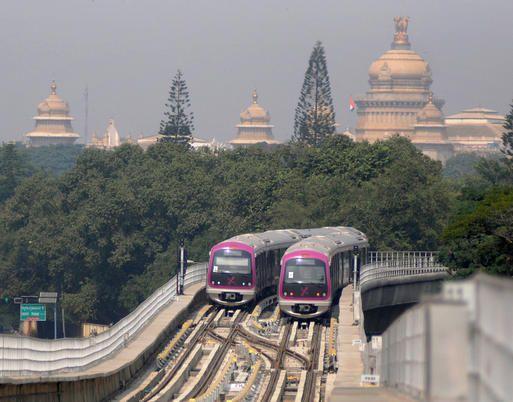
The Bangalore metro rolls in –finally!

First it was announced for December 2010. Then January 2011. Then February. Then April 4th to coincide with Ugadi, the Kannada New Year. Then nothing more was heard about the very much-anticipated launch of the Bangalore metro. Finally a date was set in September. Which was then moved to October. Everyone held their breath, and finally on October 20th, the first phase of Namma Metro (‘Our Metro’) was finally inaugurated.

“Have you been on the metro?” is the question that’s been on everyone’s lips for the past week. I took my first trip a few days after the launch. I’ve been waiting impatiently for the metro to become operational because it’s going to make life a lot easier for me since I live in walking distance of one of the stations. The first phase runs for a distance of only 6.7 kilmetres and has just six stops along the route. But the time saved in commuting is significant. Now a trip from Indiranagar to MG Road which would very often take me up to 40 minutes in an auto-rickshaw during peak traffic, takes only 7 minutes. That’s a difference of 33 minutes, which means I can spend those precious minutes doing something more constructive than sitting in an auto-rickshaw or bus and watching the world go by.

I took the metro for the first time on a Monday afternoon, just a few days after it opened. It was a working day and the stations and trains weren’t crowded. The second time was on Diwali, a public holiday. This was a whole other experience. The atmosphere was one of a fun fair or amusement park. Whole families had showed up, all dressed up in their Diwali finery, ready to test the metro. These were not the ordinary weary commuters you find in metros all over the world. These were revellers ready to celebrate a landmark event.

Security is tight, like in most public places in India. The police guard the entrances. To enter the station you have to pass through a metal detector and bags are checked. At MG Road it took 10 minutes just to enter the station because there was a long line. Then it was time to queue for a ticket which also took time. In exchange for 12 rupees, I got a black electronic token, which is scanned at the electronic turnstile when entering – and deposited in a slot when exiting.

There were a lot of Namma Metro staff around guiding people: telling them where to go, where to buy a ticket, how to scan the token, where to stand on the platform. Over enthusiastic security guards manned the platforms, ready to blow their whistles whenever someone got too close to the yellow line. Though there were many signs warning that photography is not allowed, everyone had their mobile phone out taking pictures. (None of these pictures are mine by the way!)

By the time the arrival of the train was announced, the platform was crowded. As the train appeared and was pulling into the station, the crowd was teeming with anticipation. Dozens of mobile phones filmed the arrival of the train. A symphony of shrill whistles started up as the guards warned commuters to stay behind the yellow line. As the doors opened, there was a collective cheer as everyone pushed forward, aiming for a seat. Then the doors closed and we were on our way. The noise level inside the carriage was striking. I felt like I was on a school trip. Many of the lucky ones who had got a seat promptly stood up to have a better view of the city’s rooftops going by the window. Cameras were still clicking away as people took pictures of each other taking their first trip on the metro.

Each station was announced first in Kannada, then in English, then in Hindi. I remember reading about the Delhi metro when it first opened. The intercom system had failed because so many people were using it to tell the driver to ‘go faster baba!’ But this carriage full of Namma Metro revellers were disciplined despite their obvious school kid excitement. I imagine that over the next few weeks the excitement will wear off and the shiny new car smell will fade. Then Namma Metro users will become the same nonchalant, weary commuters you see the world over.

Since my first few trips as a ‘metro tourist’ I have been a commuter, taking the metro to get to places I need to go. Though I don’t really go to the MG Road area that often, I can now find many excuses to take the metro and get off at the last stop. I can finally get a membership at the British Library. I can go to Emgee’s for Neer Dosa. I can go to Church Street to browse in the second-hand bookshops. I can easily walk to Lavelle Road from there. And if I’m travelling somewhere further than MG Road, I can take an auto-rickshaw from there to my destination, avoiding the choking traffic all the way to MG Road. Because now there’s Namma Metro.


Above: Only a tiny stretch of the metro is open now. Work is continuing on the other phases. This is what the route map will look like.

17 October 2011

Shivajinagar Scrapyard

Just next to Russell Market in Shivajinagar is a surprising place. It’s a graveyard of sorts for the carcasses of the city’s battered cars and other vehicles.

This scrap yard is where they’re dismantled and dissected.

The different body parts are then sorted: axles here, mufflers there.


Rows of small stalls sell spare parts. This is where you go if you need a headlight, hubcap, or engine for your car.