
Bellur village, Karnataka

Russell Market, Bangalore

Raghurajpur, Orissa

Mandu, Madhya Pradesh

Karaikudi, Tamil Nadu

Pondicherry

Shivajinagar, Bangalore

Russell Market, Bangalore


 After the 'big lunch', the temple is tidied up and Jagannathan once again gets a change of clothes. From 4 to 5 o’clock, another meal is served, called madhyanadupa, with sweets, curd and cakes. This must be the equivalent to ‘tea time’ for Jagannath.
My friend S and I hired an auto-rickshaw to take us 35km up the coast of the Bay of Bengal from Puri to Konark. This is the site of the magnificent Sun Temple, one of India’s 27 UNESCO World Heritage sites. This temple, dating back to the 13th century, is the representation of Surya’s (the sun god) celestial chariot. It’s well known for the intricate sculptures covering most of the temple’s structure and its 12 giant wheels.
 Above: One of the 12 giant wheels.
I was disappointed to find the temple in a sorry state. Most of the sculptures have been corroded by the elements and the passage of time. Parts of the temple have also been severely damaged by a long history of attacks, pilfering, cyclones and general neglect. The restoration work seems to have been haphazard in places: large stone blocks cover many of the sculptures and the conspicuous pink cement used to rebuild many sections is an eyesore.
But overall, this is an impressive monument and wandering through the temple is like going back to another time and place. A staircase flanked by two lions leads to the porch which was the natya mandir (dance hall). I found the detailed sculptures of dancers and musicians covering the columns and walls of the mandir exquisite (though in a state of decay).

Above: The Bhoga Mandapa (porch) believed to have once been the Natya Mandir (dance hall).

Above: A detail of the dance sculptures covering the walls and columns of the Natya Mandir.
To visit the Sun Temple, have a look at the slideshow under the section "Take a walk through..." in the right sidebar.
The Rath Yatra is the biggest festival celebrated each year in Puri – one of India’s holiest cities located on the eastern coast in the state of Orissa. The word rath means ‘chariot’ while yatra means ‘pilgrimage’ or ‘journey’. Every year, Lord Jagannath makes the journey along with his brother Lord Balabhadra and his sister Devi Subhadra, from their home at the Jagannath temple to the Gundicha temple three kilometres away where they visit their aunt for nine days.

Elaborate preparations start months before the festival day. 150 carpenters work for a two-month period on building the three huge chariots – one for each of the three deities. 20 sculptors then create the intricate wood carvings which decorate the chariots. The chariots are painted in bright colours and decorated with appliqué work. A whopping 8 million rupees (145,000EUR / 210,000CAD / 198,000USD) are spent on the preparations for the event.
 The three chariots stand ready in Grand Road.
 Devotees admiring the intricate wood carvings gracing the chariots.

The giant painted wheels of the Jagannath chariot.
This year 700,000 devotees from all over India and different parts of the world came to Puri on July 16th to witness the Rath Yatra. This is the only time of the year that non-Hindus have the chance to catch a glimpse of Lord Jagannath (as they’re not allowed into his temple – see previous article). As Jagannath is a manifestation of Lord Krishna, this is a particularly important event for Hare Krishna devotees.
On the morning of the Rath Yatra, Puri beach was crowded with pilgrims who were taking an early morning dip in the Bay of Bengal.

Grand Road, the wide thoroughfare in front of the Jagannath temple where the three chariots were standing ready for the journey, was already crowded with devotees by early morning. There were long lines at stalls offering breakfast and prasad (blessed food). There was a festive air as devotees sang and danced, playing drums and cymbals, chanting ‘Jai Jagannath!’ or ‘Hare Krishna’.
 A series of elaborate rituals prepared the deities for their journey. The idols were fed 20 dishes specially prepared for them by cooks, dressed in elaborate and colourful clothes and decorations, and swayed rhythmically as they were carried out of the temple by priests and placed in their respective chariots. The police, dressed in their distinctive khaki uniforms and wielding extra-long lathis (wooden sticks), maintained crowd control and kept Jagannath fans from getting too close to the idols.

The 200-foot long ropes attached to the chariots are pulled by devotees and mostly police officers, who try to maintain security as thousands surge forward and try to pull or at least touch the ropes which are believed to wash away sins and bring good fortune.
Balabhadra’s chariot is the first to make the trip, followed by Devi Subhadra’s chariot and then Lord Jagannath. They stay at their aunt’s place for nine days before making the trip back to their home in the Jagannath temple.
 Ganesh's tea stall is open from 3am to 9am and from 4pm to 7pm.
 Oriya girl.
 At the market.
 Offerings for the deity at Parsurameswar temple.
 Mukteswar temple with its carved gateway.
 A closer look at the stone carvings of Mukteswar temple.
 A view of the Lingaraj Temple from Bindu Sagar lake.


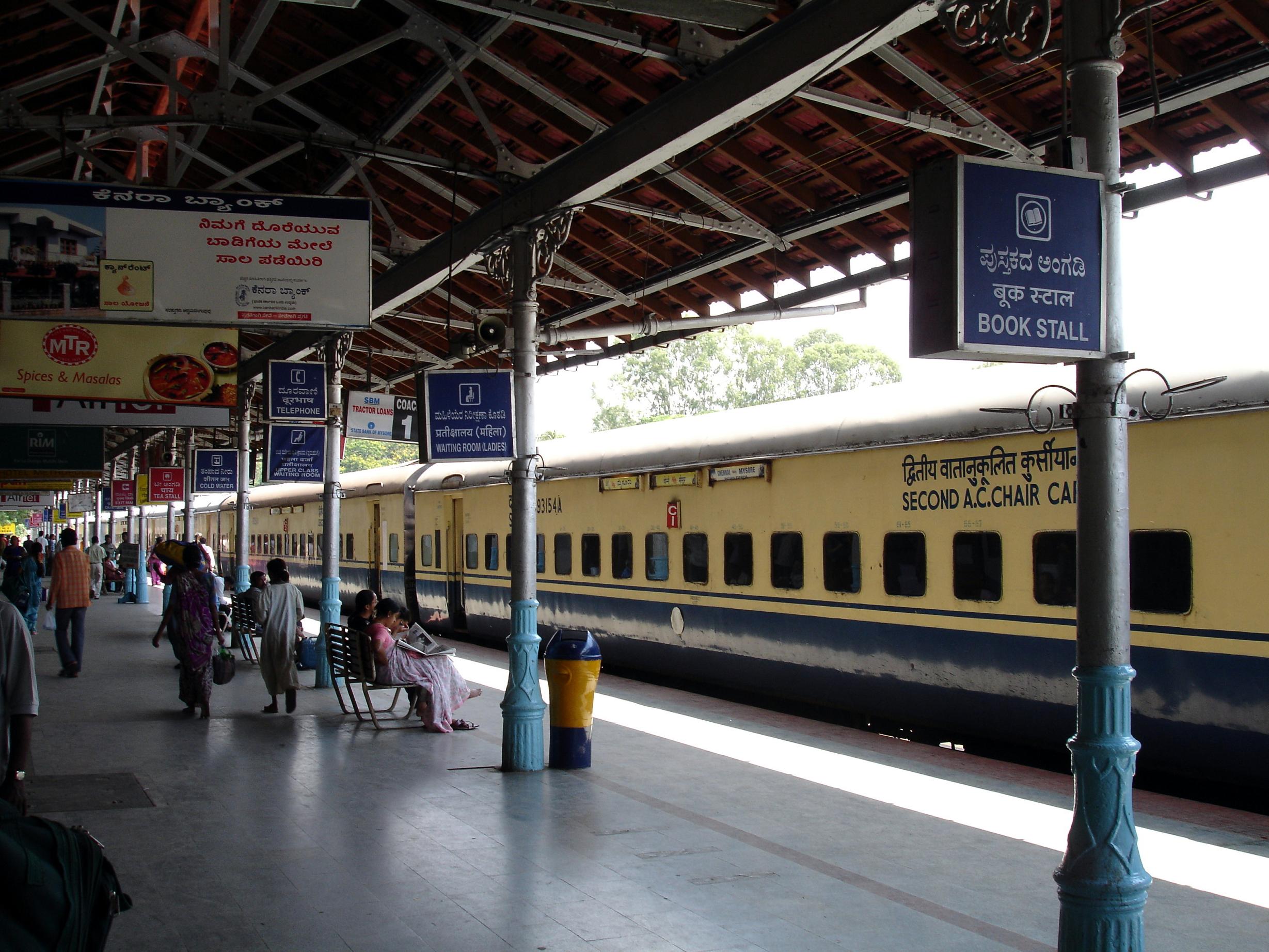
I love taking the train in India. Today many tourists and business travellers prefer to fly, thanks to the low fares offered by India’s numerous budget airlines. Flying is definitely quicker and more convenient – but nothing beats the charm and adventure of a long-distance railway journey.
Last Sunday morning at Bhubaneswar station I boarded the Yesvantpur super fast express to Bangalore. At 7am the station was a whirlwind of activity. Porters in red shirts were balancing the luggage of bleary-eyed arriving passengers on their heads, while departing passengers crowded around the information boards trying to locate their coach and berth numbers.
The platform was crowded with people – most of them there to see off their family members and friends. I soon located my coach and berth number and stowed my luggage under the seats. I was glad to see that the other people sharing my compartment were all women. Opposite me an older lady in an Orissa-style sari with a very bad cough was tended to by her daughter. She told me she was going back to her job in Bangalore after some time off at home in Orissa, and she was taking her mother with her. A student studying in Bhubaneswar was going home to Tamil Nadu. Another young woman travelling alone told me she worked at a call-centre in Bangalore. The woman sitting at the window seat was being seen off by her entire extended family – or so it seemed: a small crowd swarmed around the window offering her gifts of bananas and sweets for the journey. The compartment was already full when another woman showed up waving her ticket and claiming berth #2 as hers. Was there a mix-up? The woman travelling with her mother revealed that she was on the waiting list but that her mother had a confirmed reservation. She didn’t seem to be worried about this. She gave up her seat to the newcomer and squeezed in with the rest of us on the seat opposite.
At 7:30 sharp the train gave a jerk and started to move along the platform in slow motion. There was a flurry of waves and shouts from the platform. I surveyed the crowd as the train pulled out of the station and saw quite a few women holding up handkerchiefs to their eyes, sad to see their loved ones go so far away.
Our 1552 kilometre journey had just started. 26.5 hours later we would arrive in Bangalore, after crossing through the states of Orissa, Andhra Pradesh, Tamil Nadu and Karnataka.
Two conductors smartly dressed in khakis and navy blue blazers asked for our tickets. The woman without a confirmed reservation asked if she had a seat available and after a rummage through a huge pile of print-outs, she was assigned a berth in coach 11. This was far away from her ailing mother travelling with us in coach 2, so a young man generously offered his berth, and collecting his luggage, headed over to coach 11.
Vendors in crisp Indian Railways uniforms filed through the aisles selling tea, idly and upma for breakfast. It’s difficult to go hungry on the train in India! Soon after, ‘unofficial’ vendors in more tattier clothes appeared, offering cashew nuts, coconuts, bananas, snacks, toys and games, newspapers and magazines. These were followed by a procession of beggars: a lame man shuffling through the aisle on his hands, an old woman missing fingers, children dressed in tatters with beseeching eyes, a blind man with a beautiful singing voice, hijras (transsexuals) loudly clapping their hands and demanding money, a man with wild hair aggressively waving a metal tray in passengers’ faces and yelling “Jai Jagannath!”.
Outside, scenes of rural India flew past the window: women in brightly-coloured saris working in rice paddies, farmers tending their fields, water buffalo bathing in ponds, a schoolboy in uniform riding to school on his bicycle, a woman walking down a red dirt path balancing a pot of water on her head.
The next morning I woke up to the sounds of vendors yelling “Coffee, coffee, coffee!” and I knew I was back in the South. The student from Tamil Nadu was gone: she must have got off in the early morning. A few hours later I was back in Bangalore, only half an hour behind schedule. The Yesvantpur ‘super fast express’ had lived up to its name.
(Photo courtesy of Wikimedia Commons.)
 Above: A sign in the Meenakshi temple in Madurai
BHUBANESWAR: Food worth several lakhs meant as offering to deities at the Jagannath temple in Puri was buried on Friday morning following the entry there of an American national.
Engineer Paul F. Roediger, who came to the holy town along with two Hindus, got into the temple without knowing about entry restrictions. The servitors raised a hue and cry over his entry, thereby disturbing the rituals.
Mr. Roediger, who was detained by the police for nearly three hours, was allowed to go only after he paid a fine of Rs.209.
The food (Bada Bhog) was buried in a pit in a garden close to the temple. The temple premises were purified before the rituals resumed in the afternoon.
As per the practice in the 12th century temple, only Hindus, Jains, Sikhs and Buddhists of Indian origin or neighbouring countries are allowed entry.
First such incident
According to temple officials, this was the first incident in the history of the temple, where Bada Bhog was destroyed because of the entry of a person belonging to a different faith.
According to sources, some foreign nationals were allowed entry way back in 1959 and 1960, but with permission from the Maharaja of Puri.
Indira Gandhi was also denied entry as she had married a Parsi.


