![]() |
| Old and new in Basavanagudi |
![]() |
| Gardens make way for parking lots |
![]() |
| Old and new in Basavanagudi |
![]() |
| Gardens make way for parking lots |
Recently I took a trip to Coonoor and Ooty, two hill stations in Tamil Nadu which are nestled in the Nilgiris mountains. The Nilgiris are part of the Western Ghats mountain chain. These two hilltop towns are situated at 2286 metres (Ooty) and 1850 (Coonoor) metres above sea level. Because of the altitude, people like to go here to escape the heat, especially during the summer months of April and May.
The two hill stations are connected by the famous Nilgiri Mountain Railway, a UNESCO World Heritage site. Built in 1897 and completed in 1908, the railway climbs from an altitude of 326 metres to 2203 metres on its way from Mettupalayiyam all the way up to Ooty, passing Coonoor on the way.
This is one of the most scenic and unique railway journeys in India. I made the trip from Coonoor down to Mettupalayiyam.
We passed through lush tea plantations, eucalyptus groves and dense forests. We also passed through over a dozen tunnels and over many viaducts. The views were breathtaking.
There are many things which are unique about the Nilgiri Mountain Railway. It runs for only 45.88 km on a 1-metre gauge single-track.
The track is a ‘rack railway’, a 'toothed' railway track. The train has cog wheels which interconnect with the rack rail. This is how the train can climb and descend the sharp inclines on the way. (See an example of a cog wheel in the photo above - and spot the monkey.)
The locomotive is steam-powered. During the journey, we stopped at each station along the way so that the locomotive could be filled with water and the wheels oiled (see above).
The train stopped for some time at Hillgrove station, giving passengers the chance to disembark, stretch their legs, buy cups of tea at the station’s kiosk and feed the many monkeys.
This was a charming and picturesque railway station where time seems to have stood still.
Mr Maraiyan is the station master at Hillgrove station (he looks very serious in the photo but is actually very jovial).
There are two trains running per day between Mettupalayiyam and Ooty. The train travels at an average speed of about 10km/hour so the trip from Coonoor to Mettupalayiyam took almost 2.5 hours. The cost of the ticket was only 5 rupees. This was definitely one of the most unique and scenic train journeys I’ve taken in India.
While in Mysore, I had the chance to take in a city walking tour with Royal Mysore Walks. This was a unique way to see the city, guided by locals who know Mysore inside out and all it has to offer.
Vinay Parameswarappa (the founder), Vinay Nagaraju and Manu Bharadwaj of Royal Mysore Walks describe themselves as ‘corporate dropouts’: each of them left a high-flying but soul-destroying job in Bangalore to devote themselves to promoting the cultural heritage of Mysore, a city which is close to their hearts.
For close to three years, they have been sharing their passion and knowledge with visitors by taking them around their city, sharing interesting facts about this former kingdom, and showing them not only the many majestic palaces and monuments, but also offering fascinating glimpses into local life that many on the typical tourist trail often miss.
This being Dasara and Mysore’s most important festival, the Royal Mysore Walks team have planned a series of special Dasara walks during the 10-day festival.
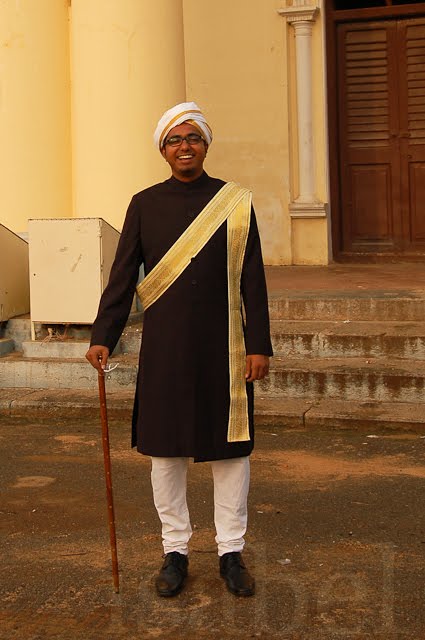
Vinay P, our guide for the Dasara Royal Walk, was all decked up in traditional ‘Durbar dress’. He explained that the city’s menfolk used to wear turbans (called ‘peta’) in the Maharaja’s day, and that the way the peta was worn indicated the person’s social standing. Vinay P was dressed up the way a minister would dress if he was invited to the Maharajah’s private durbar. Of course, no one dresses like this anymore, so a lot of research went into assembling the costume. His black overcoat had a high neck and was collarless, with six buttons running down the front. He wore a silk sash over his left shoulder. The most important part of the costume was of course the peta. The Royal Mysore Walks team managed to find someone from a family which was specialised in tying these elaborate turbans during the days of the Mysore kingdom, who gave them a crash course in turban-tying for ministers. The elegant period costume was completed with a walking stick. As our dapper guide led us through the streets of Mysore, he got quite a few curious looks and questions from the locals!
The Dasara walks also generated a lot of media interest. Journalists from local television and newspapers showed up to interview the team. They were featured in all the major newspapers the next day, as well as on television.
During the Royal Walk, we witnessed the preparations for the Mysore Dasara, which was the topic of my previous post.
Here are a few glimpses of other things we saw during our walk that day:
Guru Sweet Mart, located just outside Devaraja market, is famous for its Mysore Pak which was invented by this man’s great grandfather, Kakasara Madappa.
Pomegranate sellers and other colourful scenes from Devaraja market, a bustling 125-year-old market with more than 700 stalls.
Artisans doing inlay work in the neighbourhood of Mandi Mohalla, the home to many artists specialised in this intricate handicraft.
Sculpture students busy at work at Chamarajendra Academy of Visual Arts (CAVA)
Vinay N. and Vinay P., part of the passionate team at Royal Mysore Walks.
To learn more about their walks and other activities, visit their website.

Over the past two months, I’ve been away from my usual window, and looking through others… in Kerala, Tamil Nadu and Orissa. I’ll be sharing some glimpses of what I saw in these places in my next few posts...
One night in June, I took an overnight bus to Karaikudi, a small town in the Tamil Nadu heartland, and arrived in the early morning. I was in the heart of the Chettinad region, a unique place for many reasons.
After a nap I was ready to explore the town. Walking through the streets, I felt like I had taken a step back in time. There were few cars and many bicycles. Most of the men were dressed in lungis, and the older men were often in white.
And at every turn, I came across magnificent houses: 2-storied structures with arches, pillared verandas and ornate gates, surrounded by protective walls. Many were in a dilapidated state and looked abandoned.

These palatial homes offered a hint to a majestic past. They were built close to 100 years ago, when the Chettiars were wealthy merchants, bankers and business people. From 1870 to 1930, they traded with other lands in South-East Asia: Burma, Ceylon, Thailand, Vietnam, Malaysia. They brought their wealth home to Chettinad and built these extravagant houses richly decorated with the treasures they carried back with them: solid-teak pillars from Burma, Japanese tiles, Italian marbles and Belgian mirrors.

These houses would have at least 50 rooms, many used to store their many riches and treasures. Built on an East-West axis, a typical Chettiar house had three courtyards: the first, which was used to conduct business, was the most extravagant. The middle one was used to receive guests during weddings. And the last, towards the back of the house, had an open courtyard and was reserved for women.
The Chettinad region is made up of a collection of 75 villages over a radius of 1550 square kilometres. Only about a third of these beautiful palatial homes remain today (7-8000). There are some efforts to preserve these heritage properties. A few have been converted into hotels (like the Saratha Vilas heritage hotel below) and one will soon house the Chettinad museum.
Apart from its many palaces, Chettinad is also famous for its handicrafts. In the village of Athangudi, floor tiles are made by hand:
About six months ago, I heard the bad news. I can’t remember who I heard it from first because everyone seemed to be talking about it: Amethyst in Chennai was closing down! Why on earth would it close down?! This was my immediate reaction. This beautiful colonial mansion was a Chennai landmark. It was very popular with locals and tourists alike. It was a unique and special place. I felt physically sick when I learned why it was closing down: the family owning this heritage building decided to have it demolished and an apartment building built in its place!
Three years ago I wrote about Amethyst here. It was one of my favourite places in Chennai. This old heritage mansion in a quiet, leafy neighbourhood housed some exclusive shops but its USP was its lovely café and restaurant and beautiful garden. It was a pleasant place to spend a quiet afternoon with a good friend or a good book.
Amethyst closed at the end of December. The city has lost not only a favourite haunt for many but also an architectural and historical gem. A ‘new’ Amethyst has opened up not far away from the original, in a newly built building. An effort has been made to reproduce some of the unique atmosphere by keeping the same colonial furniture and even the floor tiles and planting a lush garden but of course it’s just not the same.
It’s unfortunate that heritage properties are not valued in India. With the property boom in recent years, many families decide that old houses and large gardens are worth sacrificing for the returns to be made in the real estate market. The financial aspect is understandable but do these architectural heirlooms have no sentimental or historical value? Why is this?
I got a partial answer when I attended a talk in Bangalore recently by Ajit Koujalgi from the Pondicherry branch of INTACH (Indian National Trust for Art and Cultural Heritage), an organisation which works to protect India’s architectural heritage. According to Mr Koujalgi, Indians seem to value property less than land. Land is more important than buildings. They are not attached to their houses. What they value more is intangible heritage like family, values, rituals and religion.
A city’s unique character is lost when its traditional architecture is torn down to make way for the shiny brand-new. Unfortunately there are no laws in India protecting heritage properties. According to INTACH Pondicherry, 60% of the city’s 1500 listed buildings have been demolished in the last 10 years! But they are doing their best to try to preserve the architectural and urban heritage of Pondicherry, which sets an example for other Indian cities. Mr Koujalgi explained that it’s been a long and tough battle trying to garner government interest and support for the restoration of Pondicherry’s heritage buildings. Preservation for preservation’s sake was not enough to convince government officials. But when they focussed on the potential for the promotion of tourism that heritage conservation has, more people took interest. There are more and more heritage buildings in Pondicherry being converted into shops, hotels and restaurants, and yes weekends see the arrival of many visitors coming to soak in the city’s unique charm.
Here are some other examples of heritage properties in Pondicherry which have been restored thanks to the efforts of INTACH:


If you go to Pondicherry, visit the INTACH Heritage Centre, located in a beautifully-restored traditional Tamil-style house.
Pick up a copy of the Heritage Trail Map here or at the Tourist Office.
INTACH also organises Heritage Walks during the tourist season (November to February).
INTACH, 62 rue Aurobindo Street, Pondicherry, tel: +91 (0)413 222 5991, www.intachpondicherry.org
(Pondicherry photos courtesy of Tourist Office)