26 January 2015
No more trains to Hillgrove station
11 January 2015
December in Chennai
This December 26th marked the 10th anniversary of the tsunami, a natural disaster which is etched in everyone’s memory. On that morning, I walked to Marina Beach to commemorate this in a quiet and personal way. From Mylapore, it was a short walk to the sea. My walk along the beach started just behind Santhome Cathedral. It was around 7:30am, almost exactly the time the tsunami had struck this beach and where 131 persons perished (a total of 18,000 had lost their lives in coastal India). The scenes of everyday life I was seeing were probably the same 10 years ago. As I headed north, I saw a group of fishermen untangling their nets, while women sold fish from makeshift stalls, their heads covered to protect from the ‘cold’. There were rows of concrete structures in a bad state. Where they destroyed during the tsunami? I saw that people were still living in them. A little further away were newer buildings which may have been built to re-house those who had lost their homes in the waves. Further ahead, near the Gandhi statue, the beach was busy with morning walkers and joggers and people meditating or just enjoying the first hours of this December morning. It was a grey, overcast day. I didn’t see any type of commemoration happening but later I read in the paper that this was planned for later in the day.
24 February 2013
A ride on the Nilgiri Mountain Railway
Recently I took a trip to Coonoor and Ooty, two hill stations in Tamil Nadu which are nestled in the Nilgiris mountains. The Nilgiris are part of the Western Ghats mountain chain. These two hilltop towns are situated at 2286 metres (Ooty) and 1850 (Coonoor) metres above sea level. Because of the altitude, people like to go here to escape the heat, especially during the summer months of April and May.
The two hill stations are connected by the famous Nilgiri Mountain Railway, a UNESCO World Heritage site. Built in 1897 and completed in 1908, the railway climbs from an altitude of 326 metres to 2203 metres on its way from Mettupalayiyam all the way up to Ooty, passing Coonoor on the way.
This is one of the most scenic and unique railway journeys in India. I made the trip from Coonoor down to Mettupalayiyam.
We passed through lush tea plantations, eucalyptus groves and dense forests. We also passed through over a dozen tunnels and over many viaducts. The views were breathtaking.
There are many things which are unique about the Nilgiri Mountain Railway. It runs for only 45.88 km on a 1-metre gauge single-track.
The track is a ‘rack railway’, a 'toothed' railway track. The train has cog wheels which interconnect with the rack rail. This is how the train can climb and descend the sharp inclines on the way. (See an example of a cog wheel in the photo above - and spot the monkey.)
The locomotive is steam-powered. During the journey, we stopped at each station along the way so that the locomotive could be filled with water and the wheels oiled (see above).
The train stopped for some time at Hillgrove station, giving passengers the chance to disembark, stretch their legs, buy cups of tea at the station’s kiosk and feed the many monkeys.
This was a charming and picturesque railway station where time seems to have stood still.
Mr Maraiyan is the station master at Hillgrove station (he looks very serious in the photo but is actually very jovial).
There are two trains running per day between Mettupalayiyam and Ooty. The train travels at an average speed of about 10km/hour so the trip from Coonoor to Mettupalayiyam took almost 2.5 hours. The cost of the ticket was only 5 rupees. This was definitely one of the most unique and scenic train journeys I’ve taken in India.
08 February 2013
Film frenzy

In a country which has the world’s biggest film industry and where actors are considered to be demi-gods, new releases featuring the most popular actors are major events.
Hype is built up weeks before the release. There has been much talk of veteran actor Kamal Hassan’s newest release of the Tamil film Vishwaroopam. He mortgaged his house to make the film. Then the release was delayed in Tamil Nadu because Muslim groups opposed the film and there were concerns it could disrupt law and order.
I don’t go see Tamil films but maybe I should just for the entertainment value of the film-going experience. There seems to be more happening off screen than on screen!
Consider this article on the release of Vishwaroopam in the Coimbatore edition of The Hindu:
"It was a day they dreamed of for weeks. Fans of Kamal Haasan would never forget February 7 — the day Vishwaroopam hit the screens after the ban on its screening was lifted. Cut-outs, posters, T-shirts…Kamal Haasan was everywhere. The sound of drums and crackers rent the air as his fans danced their way into movie halls.
And when Kamal appeared on screen, fans whistled, hooted, screamed and threw their hands up in the air. Some even took photos of their hero on their mobile phones. Clad in a white kurta, Kamal, as the effeminate kathak dancer Vishwanath, drew applause for the slightest side-glance — he played the role so well. His fans lapped it up; their whistles for the song ‘Unnai Kaanadha’ were deafening. One could hardly hear the song!
Kamal’s first fight sequence had the audience up on its feet. With every slow-motion stunt, the screams grew louder. But there was absolute silence as the spy-thriller progressed."
You can read the whole article here.
27 January 2013
Chantal’s passion for kolams

I had heard about Chantal before I met her. It was the director of the Mylapore Festival who had told me about this French woman passionate about kolams (also called rangoli), the intricate drawings which adorn the doorsteps of many homes in India. This annual neighbourhood festival features a kolam contest and Chantal is there every year, taking photographs. Then I came across her name more recently, while reading a book on Chennai. In a chapter about Mylapore, the author mentions a few foreigners who have a fascination for this vibrant neighbourhood and visit it every year during the Margazhi season (which falls in December) to soak in everything it has to offer.
Like many other dance and music lovers, I’m also a regular visitor to Chennai every December and have been attending the ‘December Season’ since 2002. It’s not only the music and dance I enjoy, but also the lasting friendships I make with others who are passionate about the Indian arts.
We were introduced by mutual friends. I have always been fascinated by the intricate beauty of kolams and so was happy to meet Chantal who has written two books on this traditional art. She also has a deep interest in Indian classical dance, having studied Mohiniattam and Kathakali in Kerala for many years. So we had many things to discuss and share.
As we were exchanging mobile numbers, email addresses and website links, I was delighted when she said: “India Outside My Window, C'EST TOI??” So she had also had a first contact with me through my blog, which she had already visited and said she appreciates for its high quality. Thank you Chantal!
With her long black braid, kohl-rimmed eyes, Indian clothes and tilak mark on her forehead, Chantal manages to blend in in Mylapore, while not going unnoticed. Many of the kolam-drawing maamis of this conservative neighbourhood have had the opportunity to meet Chantal and have their designs photographed by her over the years she’s spent studying and documenting the kolams of Tamil Nadu.
Since we were both staying near the Kapaleshwarar Temple, I asked if I could join her on her early morning wanderings through the narrow streets of Mylapore on her search for the first kolams of the day. She was more than happy to have company.
We meet at 6am in front of her hotel, and rush off hurriedly down a side street in a part of Mylapore I had never explored before. It is at dawn that pious Brahmin women carry out the task of drawing a kolam on their doorsteps. “I want to catch the women while they’re still drawing the kolams,” she explains. “Because afterwards they quickly get erased by footsteps and scooter tires.”
We don’t go far before we come across a dark figure in the half-light, stooped over from the hips, drawing snake-like interlacing lines around carefully placed dots. “This is a sikku kolam,” Chantal explains. I had seen this style of kolam many times but had no clue it had a name. The lines are formed effortlessly, creating a perfectly symmetrical pattern. But I know that drawing a kolam is not as easy as it looks. The fine rice powder is carefully ‘poured’ between the fingers onto the ground to create an even line. Some women can even draw two parallel lines simultaneously with ease.
“Did you hear that?” Chantal asks me. It was the sound of a drum at a distance. “That means the procession is underway.” We rush off towards the sound, towards the Vishnu temple. Since Mylapore is dominated by the majestic Kapaleshwarar Temple dedicated to Shiva, I had no clue there’s a Vishnu temple in the same neighbourhood. “Women draw elaborate kolams along the procession path, so we’re sure to find some elaborate ones here,” she explains. We soon find a group of temple priests carrying a statue of Andal the saint on a palanquin.
We stop to admire an elaborate kolam decorating the ground in front of a corner house. “This is an Iyengar kolam,” observes Chantal. “What’s typical about kolams drawn by this Brahmin Vaishnavite community is this ribbon-like motif,” she points out. “Come, there’s a lady who lives down this street who draws beautifully.” We head off in a new direction and on the way meet Lakshmi who’s coming back from making an offering to Andal. “I haven’t been able to draw a kolam this morning,” she says to Chantal, almost apologetically. “My husband is not well.” As if to make up for it, she invites us inside. Chantal is thrilled. As we climb the stairs, she tells me in French that women also draw kolams indoors, in their puja rooms and often around the stove. She relishes the opportunity to be welcomed into a Brahmin home where she can see how women decorate the spaces which are most important to them. Lakshmi shows us her puja room which is decorated with small kolams and prayers written in Tamil.
The kolam is a wonderful example of how art is used as an everyday ritual in India. The kolam is auspicious because it protects, keeping the evil eye away, and welcomes visitors and of course the gods, especially Lakshmi, the goddess of the household, who brings prosperity.
This art is handed down from mother to daughter though sometimes it’s the household help who has the task to draw the daily kolam in front of the doorstep. Chantal feels that this tradition is not in danger of dying out, but she does notice a decline in creativity with the younger generation. That’s why she thinks the kolam contest held every year during the Mylapore festival is so important, because it stimulates the imagination of its participants. She is also happy to notice that more and more young women are taking part.
To learn more about Chantal’s work, visit her website.
26 January 2012
Doors and doorways

15 January 2012
Happy Pongal / Sankranti!

Two days ago I was on a bus travelling through Tamil Nadu from Pondicherry to Bangalore. I passed villages where the preparations for Pongal were visible. Markets were bustling and crowded, sugar cane was for sale everywhere, as well as colourful ropes and bells. I assume the bells (and maybe the ropes too but I’m not sure) are for the cattle who are revered on the third day of Pongal, to thank them for their help with the harvest.
Watching the scenes going by, I remembered that I had been on a bus at this time of year nine years ago, on my way from Villupuram to Tiruvannamalai. It was early morning and from the bus I had seen people drawing huge, elaborate rangoli designs in front of their houses, with drawings of sugar cane stalks and overflowing pots, symbolising abundance and the words Happy Pongal! written in Tamil and English. In Tamil Nadu this must be one of the most important festivals because it last three days, while in Karnataka it seems to be more low-key.
In Karnataka and other parts of India this harvest festival is called Sankranti. This morning I took a walk through my neighbourhood and here's what I saw:
This man goes door to door with his cow, playing an instrument called Nadaswaram. I see him often in the neighbourhood, not only on festival days.


I had posted pictures of Sankranti rangoli I had taken a previous year here.
12 August 2011
A visit to Chettinad

Over the past two months, I’ve been away from my usual window, and looking through others… in Kerala, Tamil Nadu and Orissa. I’ll be sharing some glimpses of what I saw in these places in my next few posts...
One night in June, I took an overnight bus to Karaikudi, a small town in the Tamil Nadu heartland, and arrived in the early morning. I was in the heart of the Chettinad region, a unique place for many reasons.
After a nap I was ready to explore the town. Walking through the streets, I felt like I had taken a step back in time. There were few cars and many bicycles. Most of the men were dressed in lungis, and the older men were often in white.
And at every turn, I came across magnificent houses: 2-storied structures with arches, pillared verandas and ornate gates, surrounded by protective walls. Many were in a dilapidated state and looked abandoned.

These palatial homes offered a hint to a majestic past. They were built close to 100 years ago, when the Chettiars were wealthy merchants, bankers and business people. From 1870 to 1930, they traded with other lands in South-East Asia: Burma, Ceylon, Thailand, Vietnam, Malaysia. They brought their wealth home to Chettinad and built these extravagant houses richly decorated with the treasures they carried back with them: solid-teak pillars from Burma, Japanese tiles, Italian marbles and Belgian mirrors.

These houses would have at least 50 rooms, many used to store their many riches and treasures. Built on an East-West axis, a typical Chettiar house had three courtyards: the first, which was used to conduct business, was the most extravagant. The middle one was used to receive guests during weddings. And the last, towards the back of the house, had an open courtyard and was reserved for women.
The Chettinad region is made up of a collection of 75 villages over a radius of 1550 square kilometres. Only about a third of these beautiful palatial homes remain today (7-8000). There are some efforts to preserve these heritage properties. A few have been converted into hotels (like the Saratha Vilas heritage hotel below) and one will soon house the Chettinad museum.
Apart from its many palaces, Chettinad is also famous for its handicrafts. In the village of Athangudi, floor tiles are made by hand:
22 September 2010
Trichy street scenes

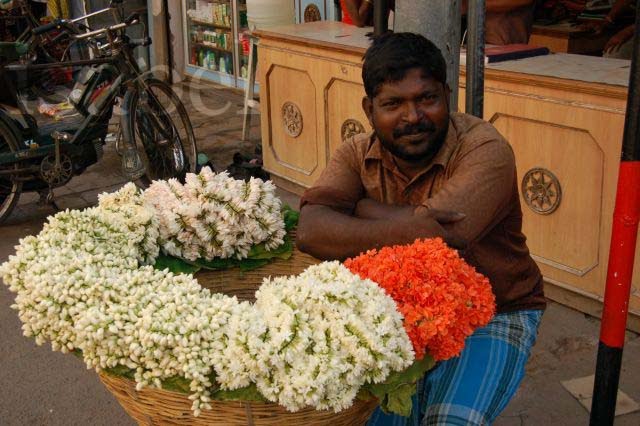
A few weeks ago I was in Tiruchirappalli, Tamil Nadu. This town is famous for its Rock Fort and is the site of some famous temples. It is also the gateway to the temple towns of South India. I captured a few scenes of street life: