06 November 2011

Gaga for guavas

I got the image above from Wikimedia.

My favourite fruit at the moment is guava. It’s been in season for the past few months and it’s for sale on almost every street corner. There are two varieties: white and pink. I’ve been told that the white fruit is sweeter than the pink. But I prefer the pink because of its beautiful, brilliant colour and I’m convinced it’s sweeter too. Pink guavas also seem to be bigger and rounder than the white. As guavas ripen, the outer skin becomes more yellow in colour.

The guava seller at the market has a big, round basket full of guavas perched on the back of a bicycle. When he sees me coming, he starts picking out the pink ones because he knows I’m gong to ask for them. For about two months there were only white guavas available but the pink ones are back now.

If you want to eat the fruit straight away, he’ll chop it up and sprinkle rock salt and chilli powder on it. But I like it the natural way: plain, no salt, no chilli. I usually ask for 5 or 6 to take home. He always gives me an extra one. Maybe because I try to speak Kannada to him, or because he’s overcharging me, or because I’m a good customer. Not sure.


30 October 2011

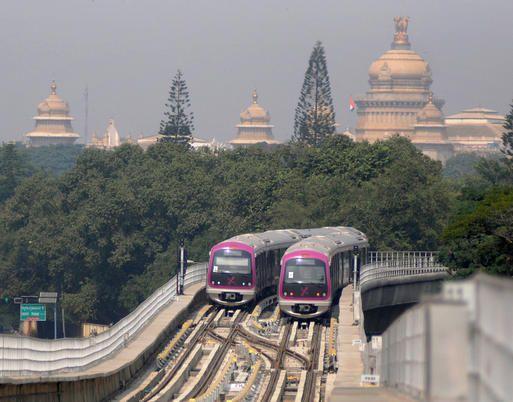
The Bangalore metro rolls in –finally!

First it was announced for December 2010. Then January 2011. Then February. Then April 4th to coincide with Ugadi, the Kannada New Year. Then nothing more was heard about the very much-anticipated launch of the Bangalore metro. Finally a date was set in September. Which was then moved to October. Everyone held their breath, and finally on October 20th, the first phase of Namma Metro (‘Our Metro’) was finally inaugurated.

“Have you been on the metro?” is the question that’s been on everyone’s lips for the past week. I took my first trip a few days after the launch. I’ve been waiting impatiently for the metro to become operational because it’s going to make life a lot easier for me since I live in walking distance of one of the stations. The first phase runs for a distance of only 6.7 kilmetres and has just six stops along the route. But the time saved in commuting is significant. Now a trip from Indiranagar to MG Road which would very often take me up to 40 minutes in an auto-rickshaw during peak traffic, takes only 7 minutes. That’s a difference of 33 minutes, which means I can spend those precious minutes doing something more constructive than sitting in an auto-rickshaw or bus and watching the world go by.

I took the metro for the first time on a Monday afternoon, just a few days after it opened. It was a working day and the stations and trains weren’t crowded. The second time was on Diwali, a public holiday. This was a whole other experience. The atmosphere was one of a fun fair or amusement park. Whole families had showed up, all dressed up in their Diwali finery, ready to test the metro. These were not the ordinary weary commuters you find in metros all over the world. These were revellers ready to celebrate a landmark event.

Security is tight, like in most public places in India. The police guard the entrances. To enter the station you have to pass through a metal detector and bags are checked. At MG Road it took 10 minutes just to enter the station because there was a long line. Then it was time to queue for a ticket which also took time. In exchange for 12 rupees, I got a black electronic token, which is scanned at the electronic turnstile when entering – and deposited in a slot when exiting.

There were a lot of Namma Metro staff around guiding people: telling them where to go, where to buy a ticket, how to scan the token, where to stand on the platform. Over enthusiastic security guards manned the platforms, ready to blow their whistles whenever someone got too close to the yellow line. Though there were many signs warning that photography is not allowed, everyone had their mobile phone out taking pictures. (None of these pictures are mine by the way!)

By the time the arrival of the train was announced, the platform was crowded. As the train appeared and was pulling into the station, the crowd was teeming with anticipation. Dozens of mobile phones filmed the arrival of the train. A symphony of shrill whistles started up as the guards warned commuters to stay behind the yellow line. As the doors opened, there was a collective cheer as everyone pushed forward, aiming for a seat. Then the doors closed and we were on our way. The noise level inside the carriage was striking. I felt like I was on a school trip. Many of the lucky ones who had got a seat promptly stood up to have a better view of the city’s rooftops going by the window. Cameras were still clicking away as people took pictures of each other taking their first trip on the metro.

Each station was announced first in Kannada, then in English, then in Hindi. I remember reading about the Delhi metro when it first opened. The intercom system had failed because so many people were using it to tell the driver to ‘go faster baba!’ But this carriage full of Namma Metro revellers were disciplined despite their obvious school kid excitement. I imagine that over the next few weeks the excitement will wear off and the shiny new car smell will fade. Then Namma Metro users will become the same nonchalant, weary commuters you see the world over.

Since my first few trips as a ‘metro tourist’ I have been a commuter, taking the metro to get to places I need to go. Though I don’t really go to the MG Road area that often, I can now find many excuses to take the metro and get off at the last stop. I can finally get a membership at the British Library. I can go to Emgee’s for Neer Dosa. I can go to Church Street to browse in the second-hand bookshops. I can easily walk to Lavelle Road from there. And if I’m travelling somewhere further than MG Road, I can take an auto-rickshaw from there to my destination, avoiding the choking traffic all the way to MG Road. Because now there’s Namma Metro.


Above: Only a tiny stretch of the metro is open now. Work is continuing on the other phases. This is what the route map will look like.

17 October 2011

Shivajinagar Scrapyard

Just next to Russell Market in Shivajinagar is a surprising place. It’s a graveyard of sorts for the carcasses of the city’s battered cars and other vehicles.

This scrap yard is where they’re dismantled and dissected.

The different body parts are then sorted: axles here, mufflers there.


Rows of small stalls sell spare parts. This is where you go if you need a headlight, hubcap, or engine for your car.

30 September 2011

Pavement jobs

For many people in Bangalore and other Indian cities, their place of work is the city’s roads and footpaths. These entrepreneurs take their services to the places where they’re needed. A good example is the many cobblers who are found on every busy street. When my sandal broke while walking down the street one day – that most important little strip that goes between the toes detached itself from the sole of my sandal – I didn’t have to go far to find a shoemaker: about 5 metres. 2 minutes and 5 rupees later, my sandal was fixed and I could be on my way again.


There are also many bicycle repairmen who operate on street corners. Cyclists can stop to get a flat tire repaired or spoke fixed. On a road in my neighbourhood there’s a man who stands around wearing grease-stained clothes and holding tools. I always wondered what he was up to until one day I saw him in his usual spot fixing an auto-rickshaw.


Outside a post office in Calcutta I once observed a row of temporary pavement stalls selling envelopes, string, tape and anything else needed to prepare letters and packages. And a row of typists sitting on the ground behind typewriters, ready to type up any correspondence needed. I haven’t seen this in Bangalore, but I took the photo below in Pondicherry.

This mobile workshop belongs to a key maker who works on the roadside:


This knife-sharpener walks the streets offering his services. This reminds me of the sound of a bell that I would hear in my neighbourhood when I was growing up in Toronto. The regular cling-clang sound would come closer and closer. My mother would gather up all the knives which had gone blunt and take them outside to the knife-sharpener who’d sharpen them on the sidewalk. I wonder if he still comes by.


23 September 2011

Drumming the point home

I haven’t written about sounds for a while, and since my blog is all about the colours, sights and sounds of South India, it’s time to make some noise.

The sound of drumming is a sound I hear often in my neighbourhood, especially since the festive season started with Ganesh Chaturthi. Processions carrying large idols of the god to the nearest lake for immersion are almost always accompanied by a posse of drummers drumming along energetically.

But in today’s paper, I read about drumming of a different kind… the city authorities have decided to hire drummers to drum a point home and embarrass tax defaulters into paying up. Apparently this tactic was a ‘thumping success’:

The Hindu, BANGALORE, September 23, 2011

It was a thumping success

STAFF REPORTER

A group of drumbeaters was hired by the Bruhat Bangalore Mahanagara Palike on Thursday to embarrass a tax defaulter on Indiranagar 100 Foot Road in HAL 2nd Stage.

In a move to force defaulters to pay up the tax, the BBMP authorities drummed home the message by hiring a set of raucous percussionists to perform before Ramachittaranjan Das, who owns a four-storey complex in the tony neighbourhood, which has been leased or rented out to multinational companies.

The owner of the property, a BBMP release said, has defaulted on property tax since 2007-08.

The dues ran up to a whopping Rs. 72 lakh, and repeated reminders were fruitless.

Thursday's initiative, however, was a thumping success. “The owner of the property has given us a cheque,” a BBMP official said.

A large number of property owners in the city are tax defaulters, owing BBMP more than Rs. 200 crore. Such drumbeating programmes have been planned in 10 places in each of the eight zones once a week to mobilise funds.

Though the Karnataka Municipal Corporations Act 1976 does not empower BBMP to beat drums, it allows it to issue notice and seize movable properties of defaulters, BBMP sources said.

20 September 2011

An afternoon at the beauty parlour

After I moved to India I quickly discovered the luxury of the beauty parlour. Of course these exist everywhere, but in India the beauty parlour seems to be an indispensable part of every self-respecting woman’s life. This is where women go on a weekly basis to get waxed and threaded, massaged and pampered.

The reason why this is a luxury I’ve indulged in only in India is because it’s so cheap. In Europe it costs at least 50 Euro (3300 rupees) for a hair cut and blow dry. For this price in India I can also get a manicure, pedicure, hair treatment and facial thrown in for that price. I admit it: I’ve become a beauty parlour junkie of sorts.

I also now know why the beauty parlour is so indispensable. Since I’m always barefoot at home and wear sandals year-round, my feet are usually in a bad state. They also take a pounding in dance class. So pedicures have become a necessity. Also, neatly-painted toenails seem to be fashionable. Then there’s my hair, which is usually a frizzy mess because of the heat and humidity. Head massages, hair spas and conditioning treatments are hard to resist. I’ve also become a fan of eyebrow threading. This was the newest trend in London five years ago. But it cost 15 pounds: 75 times more than the 15 rupees it costs here.

I also tried waxing for the first time in India. The full-leg wax was not a good experience because of an over-zealous beautician. But the half-leg wax is bearable. The beauty parlour ladies have also tried many times – unsuccessfully – to submit me to an arm wax. “Arm wax?”, I had asked them, puzzled. “You mean Indian women wax their arms?” “Yes Madam, Indian ladies do full waxing,” they assured me. This was not something I had considered before. Nor had I known that hairy arms are undesirable. I started to surreptitiously scrutinize my friends’ arms. And I discovered they were indeed hairless. So it must be true! Then a foreign friend told me her Indian husband insists she wax her arms! I was horrified at the thought that my hairy arms could be considered repulsive. Then another friend told me that she had tried waxing her arms but was appalled by the stubble that grew back. That settled it. I like my hairy arms.

The beauty parlour is also a place to exchange news with the beauty parlour ladies and read Femina magazine. And a chance to observe the hierarchy of the Indian working environment in action. The new girls are always bullied by the more senior staff. They have to do the dingy jobs like washing hair, serving tea and coffee and sweeping up bits of hair.

Another discovery for me was that the beauty parlour is not only for ladies! There are beauty parlours which cater exclusively to men while others offer services for both. Men also come to get manicured, pedicured, facialled and threaded! The beauty parlour ladies used to tell me that they offer services for men too and would ask me to “inform Sir”. ‘Sir’ would find the thought of getting a facial or pedicure hilarious. But he tells me about what goes on at the barber shop: hair cuts and head massages of course, but also hair dying, eyebrow threading and fruit-scented facials. I’m not sure about arm waxing though.


03 September 2011

Ganesh puja

This past week has been a particularly festive one. On Wednesday, the city’s Muslims celebrated Eid, while the Hindu community was celebrating Gowri puja. Thursday was a holiday on account of Ganesh Puja. This marks the beginning of the festive season. The next few months will see a flurry of festivals and celebrations: Dasara, Durga Puja, Diwali.

Earlier this week I took another trip to Pottery Town. I knew it would be particularly busy, just days before Ganesh Chaturthi. The lanes were crowded with 10-foot statues of Ganesh wrapped in plastic. Artists were busy with last-minute preparations. Trucks were being loaded with statues, with straw or newspaper used as padding to protect the fragile effigies on their way to shops. There were families shopping for a statue to take home for the puja.

Take a walk through the lanes of Pottery Town: